
When thinking of the American “Gilded Age” from the 1870s to the 1890s, what comes to mind is the widespread economic expansion of the United States, allowing it to emerge as a growing giant on the world stage as the old empires of Europe began to stagnate. It was a time of widespread industrialisation and immigration as factories opened up across the country, towards the Western frontiers, increasing real wages by up to 40%.
Politically, it was a change in the social structure of America, with corruption becoming much more dominant within the day-to-day operations of government. Yet, it was also a time of high voter turnout and political activity.
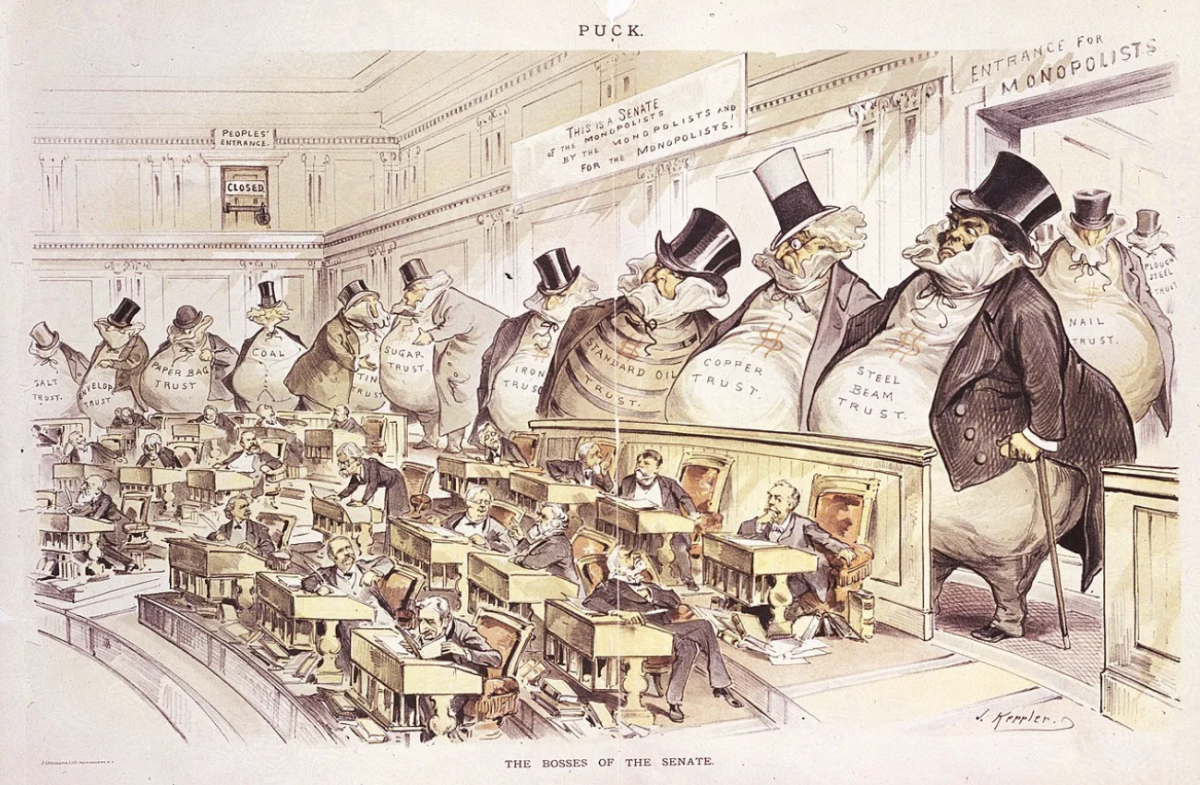
What is perhaps most significant about this time, however, was the growth of corporations and business magnates, with household names like Rockefeller’s Standard Oil, J.P. Morgan and his namesake bank, and Carnegie’s U.S. Steel beginning their increasing involvement within politics, donating campaign contributions and lobbying Congress and State governments to support their business activities. The ways in which these companies made a profit, conducted their business, expanded, and lobbied the government remain significant to this day.

Enter Theodore Roosevelt. Then, a Vice President to William McKinley. Back in that time, and even to this day, the Vice President was a relatively insignificant role. In fact, Roosevelt had been nominated as McKinley’s running mate simply to get him away from his governorship of New York, where he had begun a policy of taxing public franchises granted by the state to corporations and encouraging Corporate Responsibility, which began to agitate the current political structure. As a Vice President, Roosevelt, as a man of action, was essentially powerless, and presided over the Senate for only 4 days.
On September 6th, 1901, this would change, however, with the assassination of President McKinley at the Pan-American Exposition in New York, which swept Roosevelt to the Presidency in the immediate aftermath of McKinley’s death.

Roosevelt’s appointment as President stunned the Republican Party (then a party aligned with businesses), with many fearing that the “alliance” between the Corporations and Government, which had, in their eyes, led to the prosperity of the United States would collapse under Roosevelt’s meddling, even with his promises to continue McKinley’s economic policies and maintain the same Cabinet.
Despite the pressure from surrounding parties, Roosevelt chose to follow through with his ideals of protecting the consumer, using his Presidency to enact the “Square Deal.” Specifically, his trustbusting involved the use of the Sherman Antitrust Act of 1890, initially a law rarely used, mostly for union-busting to break up trusts that restrained trade and unfairly marked up prices.
Two of the most famous examples of this were:
- Northern Securities Company: A railway monopoly composed of 3 major railway corporations colluding as a trust, which attempted to eliminate other competition. They were broken up by the Roosevelt administration’s Justice Department and later formally dissolved in 1904 by the Supreme Court.
- Standard Oil: A petroleum trust that, at one time, controlled almost 80% of the US oil supply. Reports by journalist Ida Tarbell brought the corporation’s practices in eliminating competition by undercutting prices and aggressively absorbing or bankrupting competition into the public eye, encouraging the government to heavily regulate the company.
The actions of Roosevelt during his first years of the Presidency were, however, marked by an air of skepticism, especially given that he had inherited the position from the late President McKinley. Nonetheless, the 1902 elections, which overwhelmingly gave a large majority to the Republican Party, ensured that Roosevelt had the mandate of the people.
He would go on to create the United States Department of Commerce and Labor, including a Bureau of Corporations. Utilising his sway over the public, Congress overwhelmingly passed the law allowing its creation despite attempts by major corporations to shut down the bill.
While Roosevelt’s domestic policies are most remembered for his role in regulating and reining in Corporations, his Presidency also included the increasing role of regulation, including regulating corruption in the distribution of land for Native Americans and passing laws allowing the Interstate Commerce Commission to implement a maximum rate for railroads, regulating pipeline fees, and other aspects of railroads and their day-to-day running.
The food industry also became increasingly regulated, with the Meat Inspection Act and the Pure Food and Drug Act passed with support from the public, banning misleading labels and preservatives that contained harmful chemicals.
Roosevelt’s personal crown jewel, however, would be the creation of the National Parks, the United States Forest Service, and many reserves and preserves across the country in order to protect the increasingly exploited environment of the country.
In 1904, Roosevelt would be re-elected President, going on to face the Business Panic of 1907, where he compromised and approved U.S. Steel acquiring a nearly bankrupt steel company to save a major bank, calming the stock market’s slump.
Overall, we can safely say that Theodore Roosevelt’s contributions to the United States and the world’s economic systems cannot be understated. If the Gilded Age created the way in which modern corporations behaved, Roosevelt and his administration pioneered the way in which government responds to market action. While we take for granted the protections most governments give us to prevent our exploitation by these large firms, the creation of regulatory authorities, the breakup of monopolies, and general government involvement in handling price setting, mergers, and takeovers remain significant to this day.
Sources:
- https://www.britannica.com/biography/Theodore-Roosevelt/The-Square-Deal
- https://www.ushistory.org/us/43b.asp
- https://www.vaia.com/en-us/textbooks/economics/economics-7-edition/chapter-15/problem-3-what-is-a-public-franchise-are-all-public-franchis/#:~:text=A%20public%20franchise%20is%20a%20type%20of%20license%20or%20privilege,public%20utilities%20and%20public%20transportation.
- https://en.wikipedia.org/wiki/First_inauguration_of_Theodore_Roosevelt
- https://en.wikipedia.org/wiki/1904_United_States_presidential_election
- https://en.wikipedia.org/wiki/Northern_Securities_Company
- https://en.wikipedia.org/wiki/Theodore_Roosevelt#Trust_busting_and_regulation
- https://en.wikipedia.org/wiki/Gilded_Age
- https://en.wikipedia.org/wiki/Standard_Oil#Monopoly_charges_and_antitrust_legislation
- https://en.wikipedia.org/wiki/Ida_Tarbell