
Impressionism is the art style that’s known for beginning the French modernist art movement in the late 19th century, considered as an abstract style that focuses on colours and light rather than precision. The ‘unpolished’ look that comes from visible brushstrokes was a significant cultural change in France, as they had just emerged from realism – a style that had emphasised accuracy, often depicting the dull parts of life in the 1840s. It is perhaps the harsh subject matter that the French had been surrounded by during this era that influenced the complete shift to Impressionism in the 1860s, which highlighted the beauty in nature.
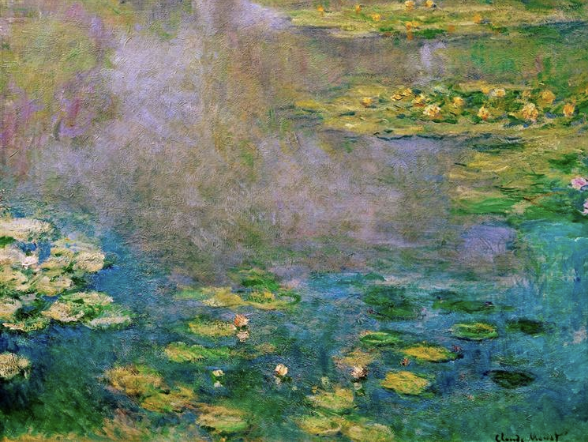
One of the most renowned artists that is linked to the revolutionary French Impressionist art period is Oscar-Claude Monet. Born on 14th November 1840, in Paris, France, Monet was central to this movement. Famous artworks such as his Water Lily series and Woman with a Parasol are timeless, recognised worldwide, and worth millions in the modern day. Instead of focusing on precision, the artist would portray spectacular hues he perceived due to the particular time of day and weather, which made his work beautiful to the eye. Monet found it important not to think of objects as exactly what they are, and rather just basic shapes of colour, to ensure it was truly his own impression of the landscape. His use of vibrancy, emphasis on lighting, and rough paint strokes is what made and makes Monet one of the most unique artists of all time.
Monet’s first strike as an artist came about when he was fifteen; he drew caricatures of classmates and teachers, and showed his initial knack for ‘out of the ordinary’ techniques. Through the influence of his artist aunt, he began working with local artists, making connections that later led him to stay in Paris from 1859-60, working at Academie Suisse. After two years of military service, Monet continued to live in Paris during 1862, studying with Charles Gleyre. Inspiration also came from Japanese prints that had vivid colours in what would usually be cool-toned landscapes.
In 1874, the artist joined a group: Anonymous Society of Painters, Sculptors, Printermakers, etc.; this society included Edgar Degas, Pierre-Auguste Renoir, Camille Pissarro, and Alfred Sisley. Their first exhibition is what officially founded Impressionism. The ‘incomplete’ style wasn’t received well by all in France – Louis Leroy describing Monet’s oil painting, “Impressionism, Sunrise” (1872), as an “unfinished impression” in a mocking manner, hence the name, Impressionism. However, over the next decade, this style became more commonly adopted and accepted in France, and realism was overruled.
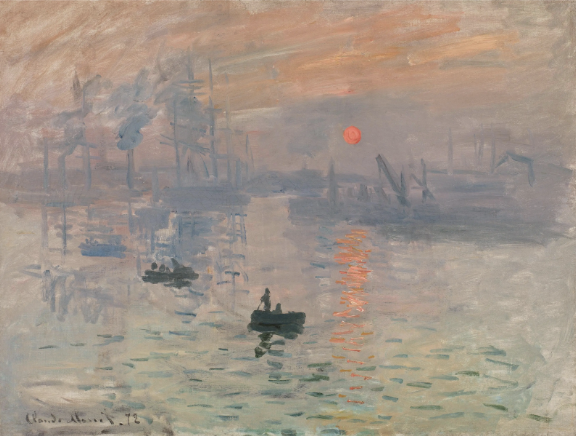
“Impression, Sunrise” by Claude Monet 1872
After the group fell in 1886, Monet had settled into Giverny, France. While he went to travel around Europe, to places such as Amsterdam and London, he seemed to have a love for his famous house and garden that he cultivated to his comfort. Some of his most famous series, such as The Japanese Footbridge and Water Lilies, were done and based on his garden in Giverny.
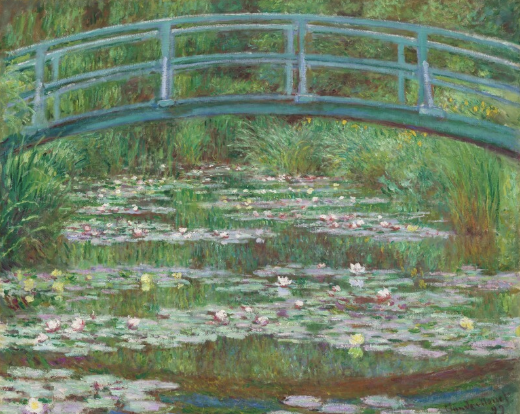
“The Japanese Bridge”, 1899
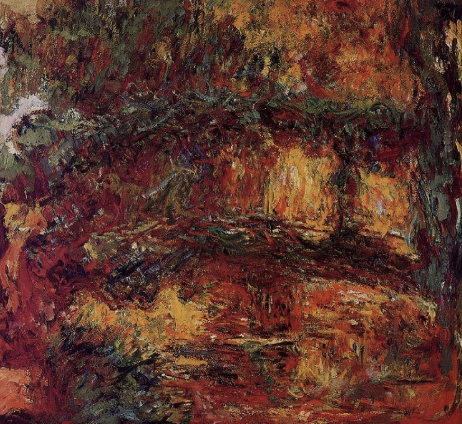
“The Japanese Bridge”, 1923
However, around the age of 72, Monet developed cataracts that caused poor vision and muddied colours. This development was evident in his work, as his vibrancy and eye for lighting in his landscapes now had a reddish tone and were significantly more abstract. The image above shows the same subject of his footbridge before and after he struggled with his sight. Unfortunately, after his cataracts developed further, he would have to paint only in little sunlight to avoid severe glare. This obviously damaged his method of working, where he used to purposely go out at different times of day and weather to capture the unique light and beauty. Monet had to heavily rely on his imagination.
Eventually, Monet became legally blind. With no vision in his right-eye and minimal sight in his left, he reluctantly had surgery a year later in 1923. His mistrust of doctors was due to fear that he would lose his special perception that made him a successful artist. However, if anything, the surgery enhanced this skill. Due to the removal of his lens in the right-eye, Monet was now one of the few who could see on the ultraviolet spectrum. Ultraviolet hues can be seen by many insects, such as butterflies and bees, and Monet essentially could see a whole new world of colour. His famous water lilies were now purple, and he shifted from his reddish tones to his lighter and naturalistic hues.
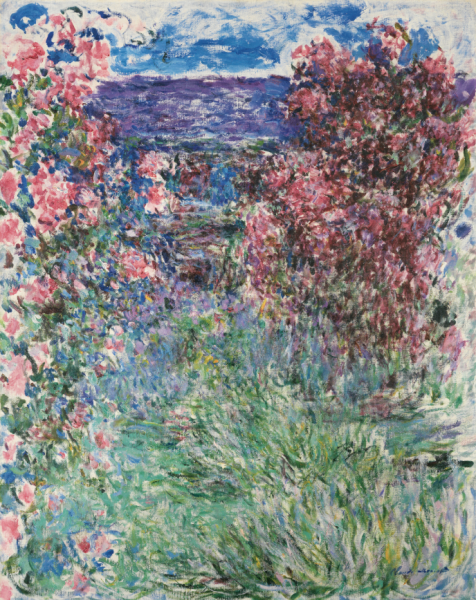
“The House among the Roses”, 1925
Monet is one of the most influential artists of all time. His focus on emotion and not technique made him stand out, and his abstract outlook on art and life was radically different from the norms of his time.
Sources:
10 Facts You Might Not Know About Claude Monet’s ‘Water Lilies’, 2026, Claude Monet, viewed 8 February 2026, <https://www.claude-monet.com/waterlilies.jsp>
Claude Monet’s Water Lilies, 2019, The Museum of Modern Art, viewed 8 February 2026, <https://www.moma.org/calendar/galleries/5110>
Could Claude Monet See Like a Bee?, 2023, Science History Institute, viewed 8 February 2026, <https://www.sciencehistory.org/stories/magazine/could-claude-monet-see-like-a-bee/>
Goretti, 2025, Did You Know That Monet Was a Master of Caricatures?, DailyArt Magazine, viewed 8 February 2026, <https://www.dailyartmagazine.com/monet-caricatures/>
History of the Water Lilies cycle, 2021, Musee de ‘Orangerie, viewed 8 February 2026 <https://www.musee-orangerie.fr/en/node/33>.
Monet & Japan, 2026, National Gallery of Australia, viewed 8 February 2026 <https://nga.gov.au/exhibitions/monet-japan/>
Seitz, WC 1999, Claude Monet Biography, Encyclopedia Britannica, viewed 8 February 2026 <https://www.britannica.com/biography/Claude-Monet>
Through the eyes of Monet, 2016, Arthive, viewed 8 February 2026, <https://arthive.com/publications/1824~Through_the_eyes_of_Monet_the_artists_special_vision_unique_retinas_and_blindness>
Vanderweide, Z 2026, 21 Facts About Claude Monet, Sotheby’s, viewed 8 February 2026 <https://www.sothebys.com/en/articles/21-facts-about-claude-monet>