
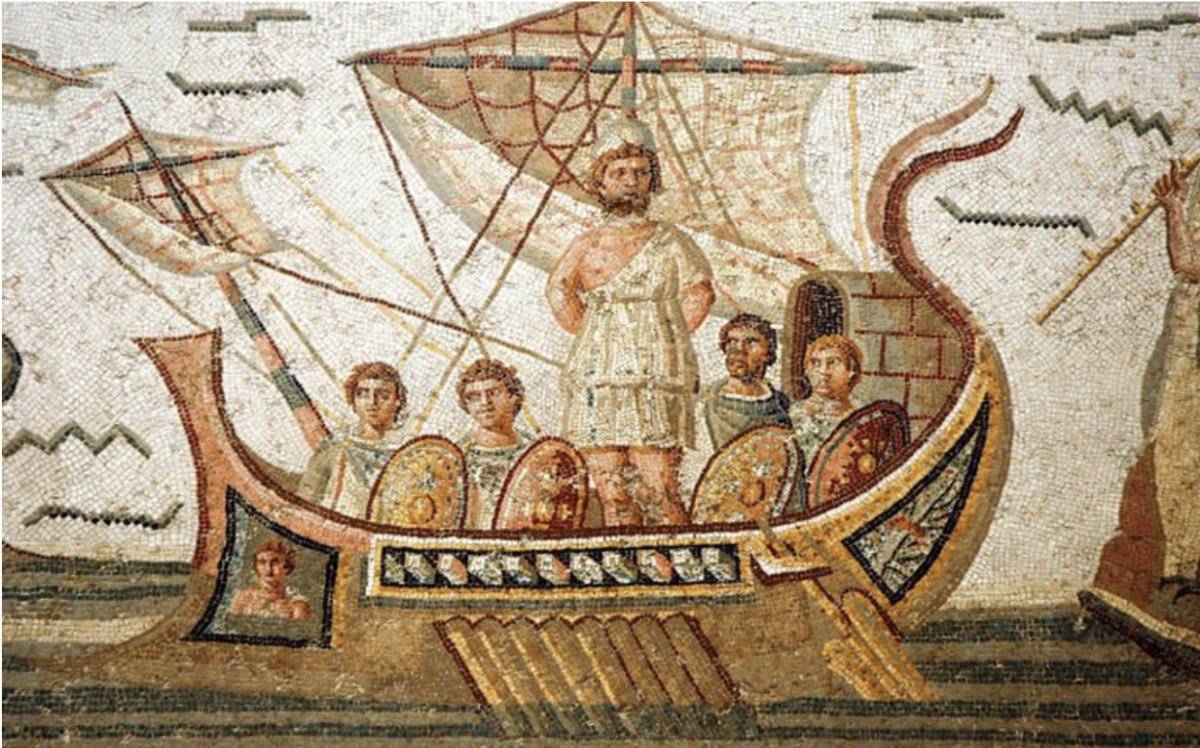
2,800 years ago, a blind poet known as Homer produced two masterpieces – The Iliad and The Odyssey. As a form of epic poetry, The Odyssey was designed to teach morals and beliefs to society through documenting the story of a man, Odysseus, rediscovering his identity on his ten-year journey home to Ithaca, where his family was waiting for him after the Trojan War in Troy.
Essentially, the core theme in The Odyssey is homecoming – linking to the philosophical question of ‘How do I know when I’m home?’ and ‘What makes home?’. The Odyssey offered Ancient Greeks themselves ideas about how to live nobly in a time when their culture consistently questioned their ideas of arete, or honour (the idea that a person strives to fulfil their highest potential and act for the good of their community).
It expresses and embeds the cultural ideas that enshrined Greek identity: heroism, hospitality, perseverance, honour, the role of the gods and family – all of which encompassed beliefs of how life should be lived.
Interestingly, it is believed Homer travelled between cities performing the poem from memory. It was verbally passed from generation to generation until it was recorded in writing in the 7th century. Modern historian Michael Wood demonstrated that in all that time, many of the original wording and phrases were maintained. It is amazing to consider ancient humans’ capacity to remember so much text prior to our age of technology when it became superfluous.
The power and legacy of the moral system, values and themes articulated in The Odyssey, which reflect Greek culture, continues centuries later. Its appeal worldwide is evident as it has been appropriated in meta-modernist interpretations through TV shows, movies, and books. From a modern perspective, what mattered to the Greeks really wasn’t too different from what matters to us and what we recognise to be humane actions of heroism. The Odyssey’s enduring readership, use and appropriation demonstrates how a different culture from years ago defined heroes, virtues and values as qualities which remain valid today.
The Greeks used particular archetypes to highlight ideal behaviours of females and males. For example, the fidelity of Odysseus’ wife, Penelope, is set in staunch juxtaposition against Helen of Troy’s infidelity in The Iliad, in which Helen left her husband King Menelaus for her lover, Paris.
Through the exploits of Odysseus, we learn of the values critical to Greek culture. These are not explicitly stated, but rather the text guides the reader through storytelling. For example, when Odysseus and his crew sack the city of Ismarus, unprovoked, killing all the men and taking all the women to stay and feast, we learn of the distasteful and costly nature of greed. Later, when the crew behave with no restraint, they are shunned by Aeolus and fall victim to Circe’s enchantments.
Whether you realise it or not, the legacy of Greek mythology is sprinkled throughout our communities today, influencing our views on ideas like justice (the idea that actions have consequences, as seen in myths where heroes are punished for hubris or wrongdoing), expected duties (sacrificing your selfish desires for the better of the people that surround you), and perseverance (in The Odyssey – never giving up throughout an extraordinarily long and dangerous mission). Hence, The Odyssey demonstrates and explains how to live with, and express, characteristics held in high regard in Greek society – honour, hospitality, faithfulness, and service to others, including the expectation of goodwill and kindness towards strangers. These values, carried across centuries, remind us that despite the distance between ancient Greece and the modern world, the qualities that define a good person remain remarkably unchanged.
Sources:
https://www.britannica.com/topic/Odyssey-epic-by-Homer
https://www.nationalgeographic.com/adventure/article/150104-homer-iliad-odyssey-greece-book-talk-tr…
https://daily.jstor.org/how-do-we-know-that-epic-poems-were-recited-from-memory/
https://www.britishmuseum.org/blog/who-was-homer
https://www.youtube.com/playlist?list=PL2vJ5Cg-wlPxcTvzl0fTKQOuZk4pe4RuA
Cover image – Photograph by Hulton Archive/Getty