
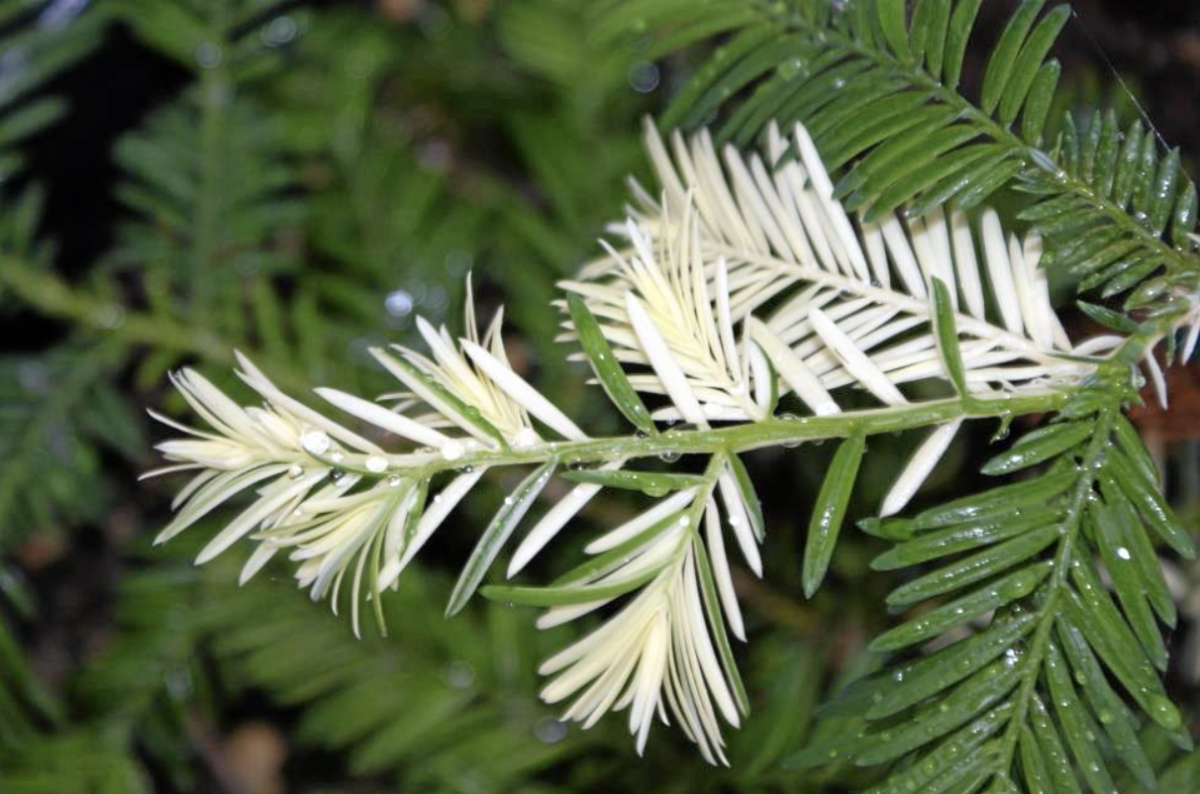
The albino redwood is unlike any other plant. A cluster of needles makes it look like an ordinary fern—until you notice the colour. Instead of the turquoise green of a healthy forest, it glows snowy white: a ghost, surviving on stolen sunlight.
The reason for its whiteness is the lack of photosynthesis in the plant. Chlorophyll allowed this process and is also the reason why plants are green, but instead of complying with the natural rule of self-making food, the Albino Redwood skips a step and goes straight to the food — by means of stealing.
First, the Albino Redwood stuck its roots in the roots of another plant. Then, it sucks out glucose from the healthy tree, because the tree thought that it was a member of its family.
However, some scientists have interpreted this exchange as a trade-off, and suggest that although the Albino Redwood takes out the glucose in the tree, it does something to return it. Evidence of weirdly high-concentration metal and toxic chemicals in the needles of the plant implies that it might have acted as a “toxic vacuum” and provided a trade-off for the mother tree by sucking up all of the toxic chemicals besides the trees.
Ultimately, the Albino Redwood challenges our basic understanding of survival. In a natural world often described as “survival of the fittest”, this ghostly parasite should not exist. By acting as both a thief of sugar and a sponge for toxins, the white redwood proves that nature is not just a series of independent battles, but a complex web of hidden deals. It reminds us that even the ” weakest ” members of an ecosystem might hold a secret purpose, turning the forest from a simple collection of trees into a mysterious, interconnected society.
Sources:
https://www.nature.com/scitable/topicpage/photosynthetic-cells-14025371/