
Let’s be honest. Before you clicked on this article, how many short-form videos did you swipe past? Five? Ten? So many that you don’t even remember? Your thumb was definitely busy. But what about your brain? Chances are, it wasn’t working nearly as hard. We’re living in the age of digital junk food, quick 15-second hits of dopamine that feel satisfying in the moment, but quietly chip away at our ability to focus and think deeply.
The problem isn’t short-form content itself. The real issue is that the brain adapts to whatever we repeatedly ask it to do. And right now, many of us aren’t training focused; we’re training distracted. Short-form platforms are designed around a “minimum effort, maximum reward” structure. One swipe, new stimulus. Bright visuals. Fast cuts. Instant emotion. The brain loves this because it gets rewarded without spending much energy. But over time, something shifts. The brain starts craving faster transitions and stronger stimulation. Long articles feel boring. Complex problems feel annoying. Finishing a single chapter of a book feels strangely exhausting.
This isn’t about weak willpower.
It’s about adaptation.
One of the most important concepts in neuroscience is neuroplasticity. The brain is not fixed; it is a living system that physically rewires itself based on repeated behavior. Circuits that are used frequently become stronger. Circuits that are ignored weaken. In simple terms: use it and it grows; neglect it, and it fades.
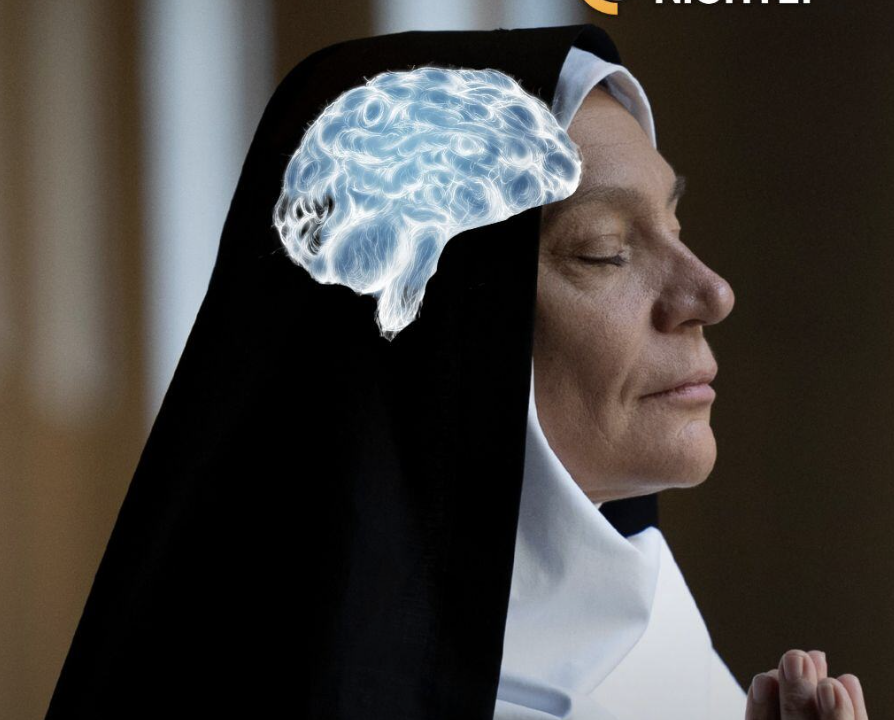
A powerful example comes from a long-term study of Catholic nuns often referred to as the “Nun Study,” conducted by researchers at the University of Kentucky. Many of these nuns remained mentally sharp well into old age, showing no visible signs of dementia during their lives. Yet after death, brain examinations revealed that some had severe Alzheimer ’s-related damage. How could this be? The answer lies in something called cognitive reserve. Over decades of reading, writing, reflection, and teaching, they built dense and flexible neural networks. Even when some pathways were damaged, alternative routes allowed their thinking to continue. Their brains had built detours.
If you look at their daily rhythm, you see something even more interesting. They began mornings with quiet reflection instead of instant stimulation. They read. They wrote. They taught. These activities heavily engage the hippocampus, the brain’s memory and meaning-making center. Later in the day, many worked in gardens, doing repetitive physical tasks. During this time, the striatum, which handles habits and routine movements, became more active. In other words, they naturally alternated between deep cognitive work and embodied, repetitive activity. This matters because the hippocampus is highly sensitive to stress. When overworked, it can shrink or become impaired. But when we shift into simpler physical activity, the brain redistributes effort. It’s like giving the thinking center a cooling period to recover.
In the evening, they wrote again, often in rich, descriptive language. Researchers found that the “idea density” in their early writings strongly predicted cognitive health decades later. There’s a big difference between writing, “I ate bread today,” and writing, “This morning the warm smell of freshly baked bread reminded me of my mother humming softly in the kitchen, and I found myself smiling.” The second version activates sensory memory, emotional circuits, and language networks all at once. The brain doesn’t store memories in drawers; it stores them in webs. The more connections you build, the more resilient the whole system becomes. Even if a pair of scissors called Alzheimer’s tries to cut through the web, the memory does not immediately collapse, because the strands are richly interconnected, information can travel through alternative paths, allowing the network to hold together even when some threads are severed.
So here’s the real question:
What kind of web are you building?
If the majority of your time is spent rapidly consuming visual stimulation, you may be strengthening visual-processing regions and reward circuits while undertraining deeper reasoning systems. Your brain is always training, whether you intend it to or not. The only real choice you have is the direction of that training.
If you want to push back, start with three simple practices.
First, build cognitive endurance. Set aside just 30 uninterrupted minutes a day. No switching tabs. No checking notifications. Finish one chapter of a book. Watch one full episode of a show without touching your phone. Train your brain to stay.
Second, try digital detox through physical activity. Spend time doing something with your body: walk, clean, cook, garden, stretch without your phone nearby. Let your brain shift into a different mode. This isn’t about productivity; it’s about neurological balance.
Third, write a three-line journal each night. Ask yourself: What did I learn today? What did I do well? What will I try differently tomorrow? But don’t write in flat summaries. Instead of “I studied,” try “There was a moment when a difficult concept suddenly clicked, and I felt a spark of excitement.” Add sensory detail. Add emotion. When you attach feeling and imagery to experience, multiple brain regions fire together, strengthening the network.
This isn’t about quitting technology. It’s about choosing what your brain becomes optimized for. Fast swiping or deep thinking. Your brain is adapting right now.
Sources:
https://alz-journals.onlinelibrary.wiley.com/doi/10.1002/alz.14626https://pubmed.ncbi.nlm.nih.gov/12965975/https://www.brainfacts.org/diseases-and-disorders/neurodegenerative-disorders/2020/what-the-brain-of-a-104-year-old-nun-taught-us-about-vascular-dementia-051420https://www.sciencedirect.com/topics/medicine-and-dentistry/nun-study