
There’s one question that has long been debated. While scientists and researchers don’t currently have an answer, what have they found out? What conclusions do people like you and I make based on their discoveries? And let’s say there is life on another planet, what is it like? This article will dive into some of those questions.
NASA Exoplanet Program
NASA is currently hosting a program to study planets outside our solar system (or exoplanets). Exoplanets are planets that orbit stars, similar to the Earth orbiting the sun. NASA scientists use telescopes (e.g., the Kepler Space Telescope or the Transiting Exoplanet Survey Satellite) to detect planets by noticing small changes in a star’s brightness when a planet passes in front of it. They then use telescopes (like the James Webb Space Telescope) to study its size, atmosphere, and temperature to see if they’re habitable.
This program could provide solid research for the search for life on another planet. Using this study, NASA could make serious breakthroughs and advance us on this mission.
K2-18b
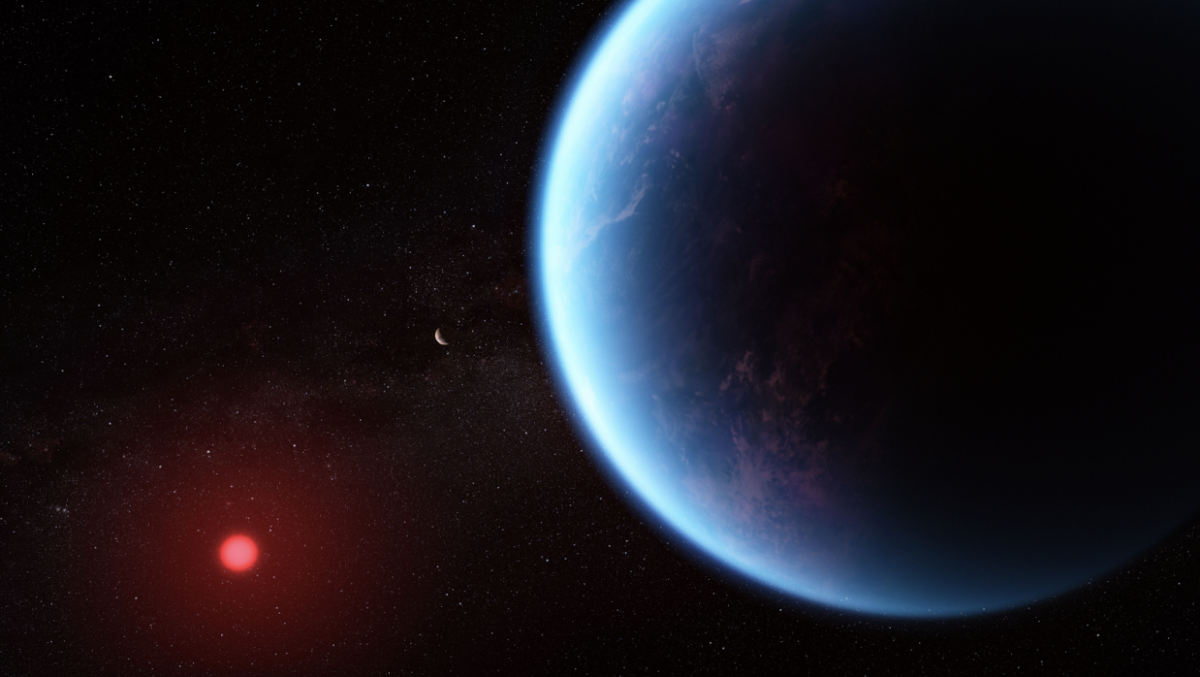
According to the BBC, scientists have found evidence of life on a planet called K2-18b. The planet K2-18b is an exoplanet orbiting the red dwarf K2-18. It’s currently 124 light-years or 700 trillion miles away from Earth and is about 2.6 times larger and 8.6 times heavier than Earth. According to researchers, it gets a similar amount of light as the Earth does from the sun. It’s thought to be a water world completely covered by an ocean.
Now, why does this big, wet planet excite scientists so much? A Cambridge team of researchers has found Dimethyl Sulphide (DMS) and dimethyl disulphide (DMDS) in the planet’s atmosphere’s chemical signature. These two molecules are typically only found in living organisms on Earth.
These two gases are produced by phytoplankton and bacteria. It was also said by Professor Padhusudhan that there was a large amount of gas detected in the planet’s atmosphere. It’s said to be ‘thousands of times higher than what we have on Earth. This means that if there really is life on this planet, there’s a lot of it.
Is This a False Call?
That being said, there’s still a chance that there isn’t life on this planet. Currently, there’s a 99.7 chance of this being true, but in science, there’s a 99.99994 chance needed for confirmation—called the five-sigma threshold. According to math, that makes us 0.29994 off.
What Can We Conclude?
While this article mainly spoke about K2-18b, there are still many other possibilities of life on another planet. Based on this exoplanet and scientific research, there’s a pretty big chance that soon we’ll be interacting with other life. Though even if there is life on this planet, it raises a number of other questions–would we be able to communicate with them? Would they have minds resembling those of humans, animals, or something entirely different? Would they actually be evil monsters who want to take over the universe?
Maybe one day we’ll get the answer to those questions, maybe we won’t.
Sources:
https://science.nasa.gov/exoplanets/missions/
https://science.nasa.gov/exoplanets/is-there-life-on-other-planets/